Ecommerce Platform Comparison: SFCC vs Shopify Plus vs SCAYLE vs BigCommerce
A comprehensive guide comparing Salesforce Commerce Cloud, Shopify Plus, SCAYLE and BigCommerce to help enterprise businesses choose the platform that best fits their operational complexity, growth strategy, AI ambitions and long-term cost requirements.
Written by
Bhumeshri Chhatani
Published on
Sep 2026
Ai Summary
Understand the differences: Compares the strengths, considerations and ideal use cases for Salesforce Commerce Cloud, Shopify Plus, SCAYLE and BigCommerce.
Compare what matters: Assesses each platform across scalability, AI, composability, international commerce, B2B, multi-brand capabilities, speed to market, TCO and migration complexity.
Look beyond features: Explores how AI, agentic commerce, architecture and total cost of ownership should influence platform selection.
Find your best fit: Uses a five-question framework based on operational complexity, speed, AI, B2B requirements and composable commerce to guide the final platform recommendation.
This summary was created with AI and reviewed by an editor
SFCC vs Shopify Plus vs SCAYLE vs BigCommerce
Choosing an ecommerce platform is one of the most important technology decisions in the modern commerce landscape. It shapes how quickly your business can respond to changing customer expectations, adopt AI, expand into new markets and manage long-term operating costs.
The platform you choose today will influence your commerce strategy for years to come.
Salesforce Commerce Cloud, Shopify Plus, SCAYLEand Commerce (formerly BigCommerce) are all proven enterprise platforms, but they're built for different business needs. That's why comparing feature lists alone rarely leads to the right decision. why comparing feature lists alone rarely leads to the right decision.
Rather than considering, which is the best platform the smarter consideration is:
Which ecommerce platform is the best fit for your business?
Most agencies can't answer that fairly, because they only deliver one or two of these platforms. We deliver all four. What follows is a genuinely neutral comparison, built on the projects we've delivered across every one of them.
In this guide you'll learn:
✔ The differences between Salesforce Commerce Cloud, Shopify Plus, SCAYLE and BigCommerce
✔ Which platform is best suited to different business models
✔ How AI, composable commerce and scalability influence platform selection
✔ Key implementation and total cost of ownership considerations
✔ A five-question framework to reach your own recommendation
The Core Difference
Each platform has evolved to solve a different set of commercial and operational challenges. Understanding that philosophy provides a far better starting point than comparing individual capabilities.
Salesforce Commerce Cloud
Best for Enterprise Retailers Seeking Connected Commerce
Salesforce Commerce Cloud is built for organisations managing complex digital commerce operations. Multiple brands, international operations, sophisticated promotions and connected customer journeys are exactly the kinds of challenges it was designed to solve.
Storefront Next represents one of the platform's biggest architectural changes in years. Rather than replacing the proven commerce engine, Salesforce has modernised the experience layer, giving retailers a faster, more flexible storefront while preserving the enterprise capabilities already in place.
Salesforce's AI strategy has also become much clearer. Through Agentforce, the platform is moving beyond AI assistants towards autonomous agents that can support merchandising, customer service and commerce operations.
Organisations should be prepared for greater implementation complexity than platforms designed around simplicity. Businesses benefit most when they have experienced implementation partners and a clear long-term commerce strategy.
Shopify Plus
Best for High-Growth Brands Focused on Speed and Agility
While Salesforce Commerce Cloud is designed for enterprise complexity, Shopify Plus takes almost the opposite approach. It removes friction, helping merchants launch faster, manage stores more efficiently and spend less time maintaining the platform.
Its strength lies in combining simplicity with enterprise capability. Backed by a mature app ecosystem, continuous innovation and built-in infrastructure management, Shopify Plus enables businesses to scale quickly without increasing operational overhead. For fast-growing brands and organisations prioritising speed to market, it remains one of the strongest enterprise commerce platforms available.
Strengths
Rapid implementation
Strong merchant experience
Excellent ecosystem
Fast innovation cycle
Scalable international commerce
Considerations
Shopify's opinionated architecture enables speed but may require organisations with highly bespoke operational requirements to evaluate whether the platform's standardised approach aligns with their long-term needs.
SCAYLE
Best for Enterprise Retailers Managing Complex Commerce Operations
SCAYLE was developed from the technology platform powering ABOUT YOU, one of Europe's largest online fashion retailers. That retail heritage is what makes SCAYLE different. Rather than requiring multiple third-party solutions, SCAYLE combines composable architecture with built-in capabilities for multi-brand management, international commerce, promotions, search and order management.
For retailers operating across multiple brands and markets, SCAYLE offers enterprise flexibility with significantly less integration effort.
Strengths
Designed specifically for enterprise retail
Strong multi-brand and multi-market capabilities
API-first, composable architecture
Extensive out-of-the-box commerce functionality
Proven scalability across high-volume retail operations
Considerations
SCAYLE continues to expand globally but has a smaller implementation ecosystem than Salesforce Commerce Cloud or Shopify Plus. Organisations should evaluate partner expertise alongside platform capabilities during the selection process.
BigCommerce
Best for Open SaaS and B2B Commerce
BigCommerce occupies an interesting position in the enterprise market. It combines Open SaaS ecommerce platform’s with mature B2B capabilities, making it well suited to manufacturers, wholesalers and businesses operating across both B2B and B2C channels.
For businesses seeking enterprise capabilities without committing to a highly opinionated platform architecture, BigCommerce offers a flexible alternative.
Strengths
Strong B2B capabilities
Open SaaS architecture
Headless and composable ready
Extensive API framework
Flexible integration ecosystem
Considerations
While BigCommerce delivers significant flexibility, organisations with highly complex retail operations should carefully evaluate whether the platform's merchandising and enterprise retail capabilities align with their long-term requirements.
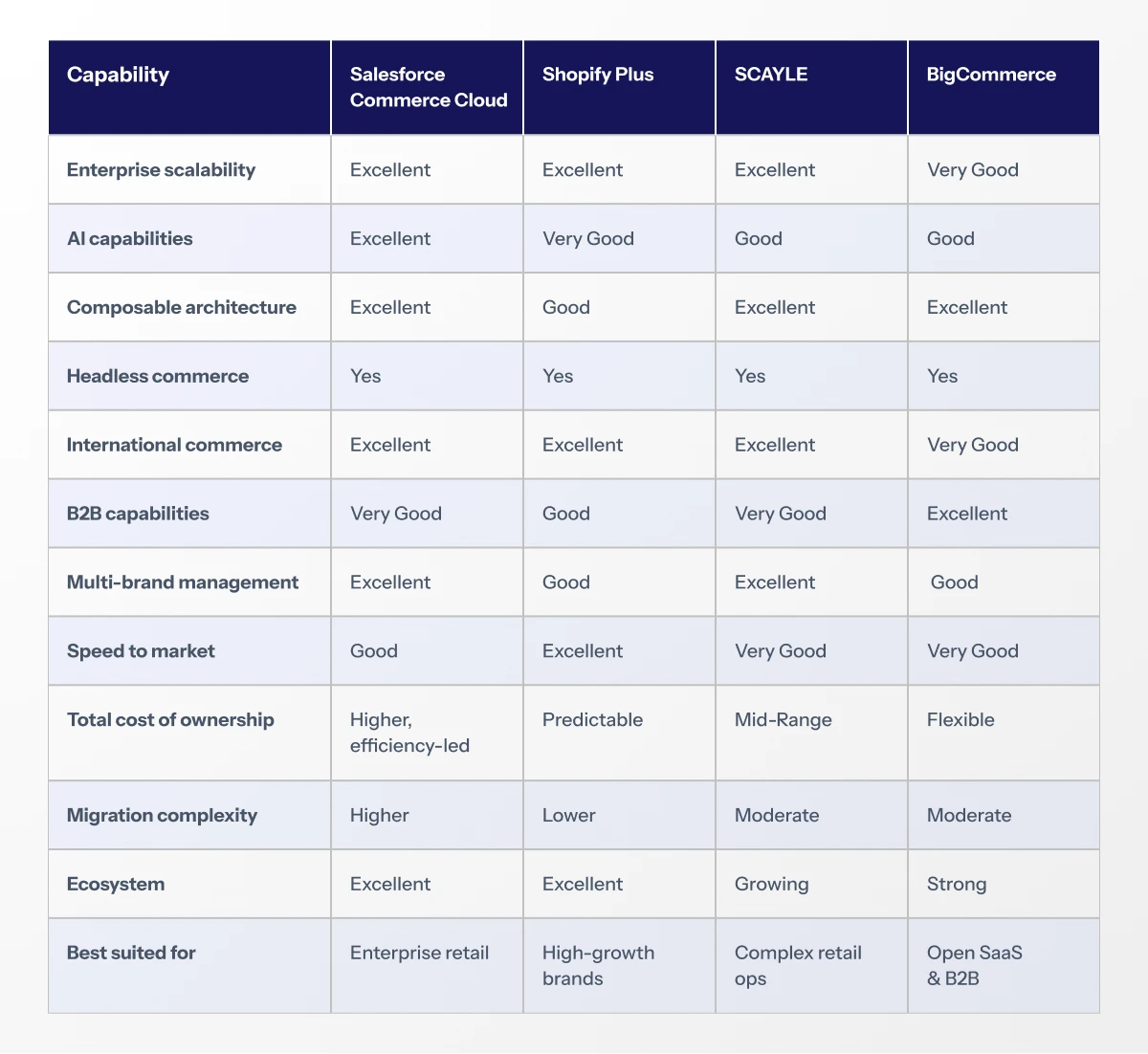
Enterprise Ecommerce Platform Comparison
A side-by-side comparison across the twelve dimensions that matter most to enterprise buyers, including total cost of ownership and migration complexity.
SFCC vs Shopify Plus
This comparison ultimately comes down to complexity versus speed. Salesforce Commerce Cloud is designed for organisations managing connected enterprise operations across brands, regions and customer touchpoints. Shopify Plus focuses on helping brands launch, scale and innovate faster with less operational complexity. Choose SFCC for enterprise depth; choose Shopify Plus for speed, agility and ease of management.
SCAYLE vs Shopify Plus
Both scale internationally, but they start from opposite places. SCAYLE is built for operational depth, multi-brand, multi-market retail with composable architecture and extensive out-of-the-box commerce functionality. Shopify Plus is built for merchant agility and speed. If your complexity lives in operations and merchandising, SCAYLE fits. If it lives in how quickly you need to move, Shopify Plus does.
BigCommerce vs Salesforce Commerce Cloud
This comparison is about architectural flexibility versus connected enterprise commerce. BigCommerce offers Open SaaS flexibility and strong native B2B capabilities, while Salesforce Commerce Cloud delivers a deeply connected ecosystem spanning commerce, marketing and customer service. The right choice depends on whether your priority is platform flexibility or enterprise integration
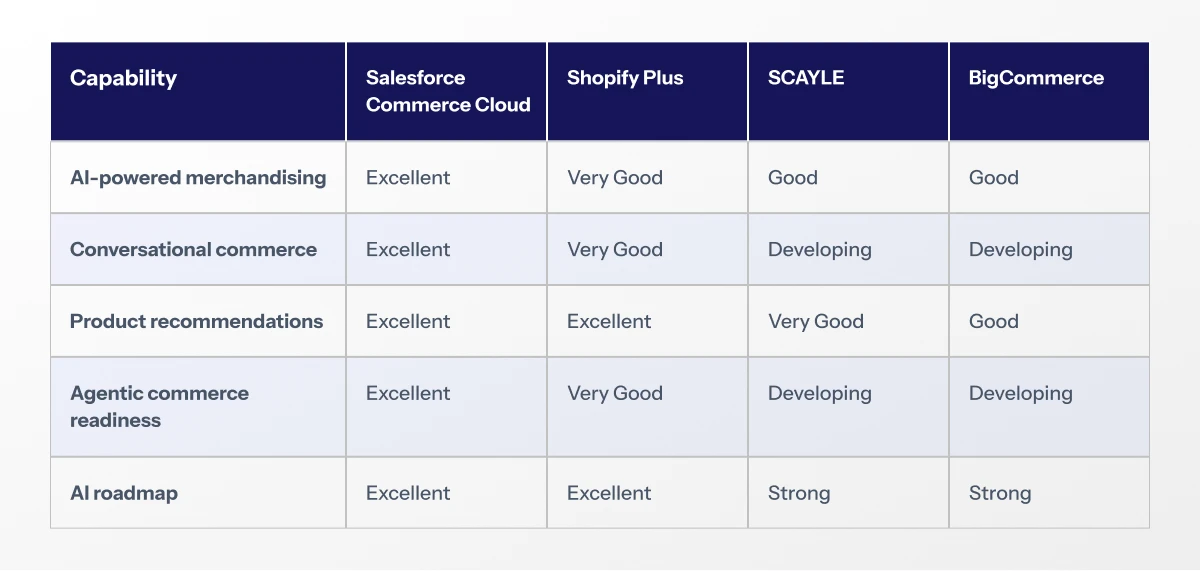
AI is rapidly changing how customers discover, evaluate and purchase products. Increasingly, ecommerce platforms are embedding AI into merchandising, search, customer service and operational workflows.
Rather than asking which platform offers the most AI features, organisations should consider how effectively each platform enables AI-driven commerce within their broader digital ecosystem and whether an AI culture is invested in its people.
Salesforce currently leads with Agentforce, while Shopify continues to invest in Shopify Magic and Sidekick. SCAYLE and BigCommerce are also expanding their AI capabilities through platform innovation and ecosystem integrations.
For most organisations, AI readiness should be considered alongside data quality, customer strategy and operational maturity rather than as a standalone purchasing criterion.
Total Cost of Ownership
Licence fees are often the first figure organisations compare, but they rarely determine long-term value. The real cost of ownership includes implementation, integrations, ongoing support, upgrades and the internal capability required to keep the platform evolving.
When comparing platforms, consider not only upfront costs but also how quickly you can deliver new functionality, support future growth and reduce operational effort over time.
Questions worth considering include:
How quickly can new functionality be delivered?
How much ongoing development is required?
What level of internal technical expertise is needed?
How easily can new markets, brands or channels be supported?
Will AI capabilities reduce manual effort over time?
Often, a platform with higher licensing costs delivers a lower total cost of ownership through greater operational efficiency and reduced technical complexity
Five Questions to Reach Your Platform Recommendation
Work through these in order. Your answers point clearly towards one platform.
1. How complex are your operations? High complexity across brands and markets points to SFCC or SCAYLE. Lower complexity favours Shopify Plus or BigCommerce.
2. How fast do you need to launch or expand? If speed is the priority, Shopify Plus leads.
3. How central is AI to your strategy? A deep AI roadmap points to Salesforce Commerce Cloud.
4. Is your business primarily B2B? Strong native B2B points to BigCommerce.
5. Do you need composable architecture with retail depth built in? That's SCAYLE's core strength.
The right platform should support not only today's requirements but also your future operating model, expansion strategy and customer experience ambitions.
Frequently Asked Questions
Which ecommerce platform is best for enterprise retailers?
There is no universal "best" platform. Salesforce Commerce Cloud, Shopify Plus, SCAYLE and BigCommerce each support different business models, operational requirements and growth strategies.
Can I migrate from Magento to these platforms?
Yes. Magento migrations to Shopify Plus, Salesforce Commerce Cloud, SCAYLE and BigCommerce are all well-established paths. The complexity depends on catalogue size, integrations and customisation. A structured migration plan protects SEO, data integrity and trading continuity through the move.
Is Shopify Plus suitable for enterprise businesses?
Yes. Shopify Plus supports many enterprise retailers, particularly organisations prioritising speed, scalability and operational simplicity.
What is the difference between Salesforce Commerce Cloud and Shopify Plus?
Salesforce Commerce Cloud focuses on unified enterprise commerce and deep ecosystem integration, while Shopify Plus prioritises merchant agility, rapid deployment and ease of use.
Is SCAYLE a composable commerce platform?
Yes. SCAYLE is built on an API-first, composable architecture while providing extensive out-of-the-box enterprise commerce functionality.
Which ecommerce platform is best for B2B?
BigCommerce offers particularly strong native B2B capabilities, although Salesforce Commerce Cloud and SCAYLE also support complex B2B commerce strategies.
How do I choose the right ecommerce platform?
Successful platform selection begins with understanding your business objectives, operating model and long-term growth strategy before comparing individual features.
Conclusion
Each of these platforms has earned its place in the enterprise market for good reason. The challenge isn't identifying the platform with the longest feature list. It's understanding which one best supports the way your business operates today and where it needs to be tomorrow.
At The Commerce Team Global, we help organisations navigate complex ecommerce decisions across multiple platforms and technologies. Our recommendations are guided by business fit rather than platform preference, ensuring technology decisions support long-term commercial success rather than short-term implementation goals.
.svg)