How to Choose an Ecommerce Agency in 2026: A Buyer's Guide for Mid-Market and Enterprise Commerce Leaders
A practical guide to help mid‑market and enterprise commerce leaders choose the right ecommerce agency by focusing on real delivery expertise, strategic discovery and long‑term post‑launch support.
Written by
Bhumeshri Chhatani
Published on
Sep 2026
Ai Summary
Know what to evaluate: Learn the key factors to consider when choosing an ecommerce agency, from platform expertise and discovery to architecture, integrations and QA.
Ask the right questions: Use eight practical questions to assess an agency's expertise, commercial model, case studies, post-launch support and ability to challenge your thinking.
Spot the warning signs: Identify common ecommerce agency red flags, including weak discovery, unclear support, limited senior involvement and a focus on visuals over measurable outcomes.
Choose the right type of partner: Understand when a platform specialist is the right choice and when a broader commerce partner can provide greater strategic and technical value.
This summary was created with AI and reviewed by an editor
Choosing the right ecommerce agency is one of the most important decisions an organisation will make during its digital commerce journey.
Every agency website promises innovation. Every pitch deck promises transformation. Every case study claims success. Yet once contracts are signed, the differences quickly become obvious. Some agencies deliver projects. Others become long-term commerce partners, helping organisations launch faster, trade more effectively, adapt to changing customer expectations and continuously improve long after go-live.
The challenge isn't finding an ecommerce agency. It's identifying which one is genuinely equipped to support the business you're building, not simply the website you're launching.
At a Glance
In this guide you'll learn:
✔ The eight questions every organisation should ask before appointing an ecommerce agency
✔ The warning signs that indicate delivery risk
✔ How to compare agencies beyond awards and day rates
✔ Whether a specialist or full-service commerce partner is right for your business
✔ Why post-launch support is often more important than implementation itself
✔ How to choose a partner that creates long-term commercial value
Why This Decision Matters More Than Ever
Enterprise commerce has changed significantly over the last few years.
Technology stacks have become more complex as businesses adopt headless commerce, composable commerce and omnichannel operating models. Customer expectations continue to rise, while AI is reshaping search, merchandising, customer service and product discovery. Budgets are under greater scrutiny more than ever.
At the same time, organisations have more platform choice than ever before. Salesforce Commerce Cloud, Shopify Plus, SCAYLE and more can all be excellent solutions, but only when aligned with the right operating model, internal capability and growth strategy.
Choosing an ecommerce agency is no longer simply about delivering a new storefront. The most successful commerce programmes succeed because technology decisions are aligned with operational and commercial realities from the start.
Why Many Commerce Projects Struggle Despite Choosing the Right Platform
One of the most common misconceptions in ecommerce transformation is that platform selection determines success. In reality, many delivery challenges stem from organisational factors rather than technology limitations.
After supporting hundreds of ecommerce projects, we've seen organisations invest in powerful enterprise platforms only to discover internal processes, governance models or operational workflows aren't ready to support them. Equally, we've seen businesses outgrow seemingly suitable platforms because international expansion, complex integrations or evolving customer expectations weren't fully considered during planning.
What Does an Ecommerce Agency Actually Do?
Many organisations think an ecommerce agency builds websites. The best ecommerce agencies do much more than that. They help businesses make better technology decisions, reduce delivery risk and continuously improve digital performance.
Digital commerce strategy and technical consultancy
Platform selection including replatforming and migration
Commerce implementation and solution architecture
Headless & composable commerce
Systems integration
UX and customer experience
Performance optimisation
Quality assurance
Managed services with specialist engineers
AI and automation
You're not buying development capacity. You're investing in expertise that influences customer experience, operational efficiency and long-term return on your technology investment.
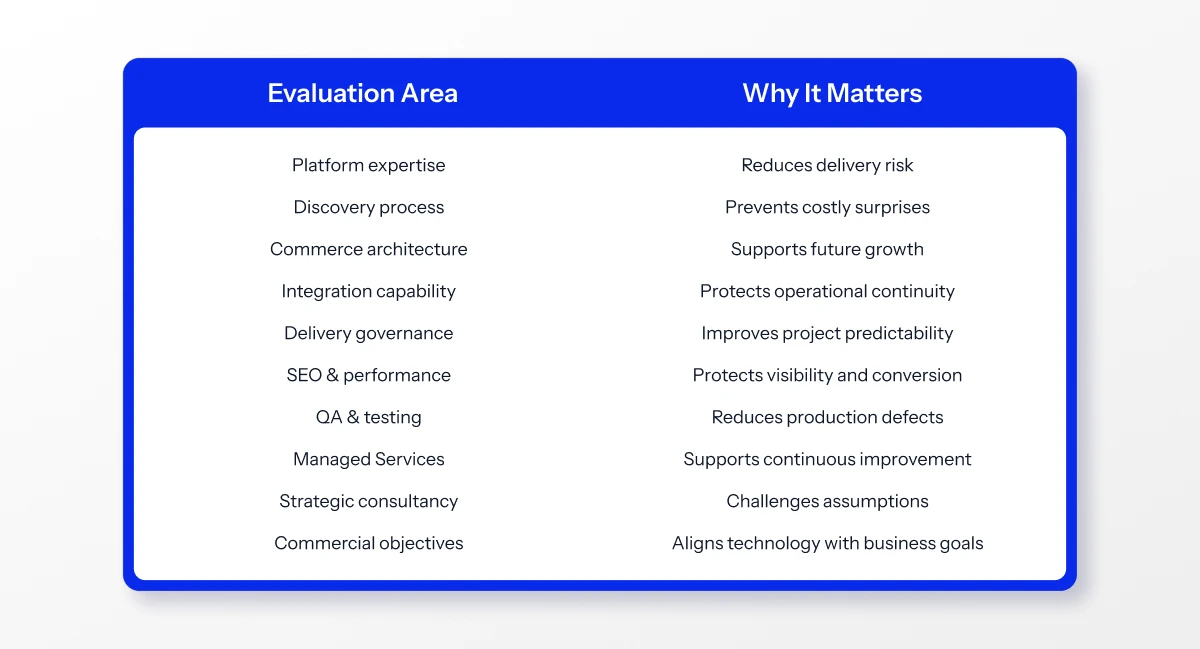
The Commerce Partner Evaluation Framework
After delivering more than 500 ecommerce projects across global commerce platforms, one thing has become clear.
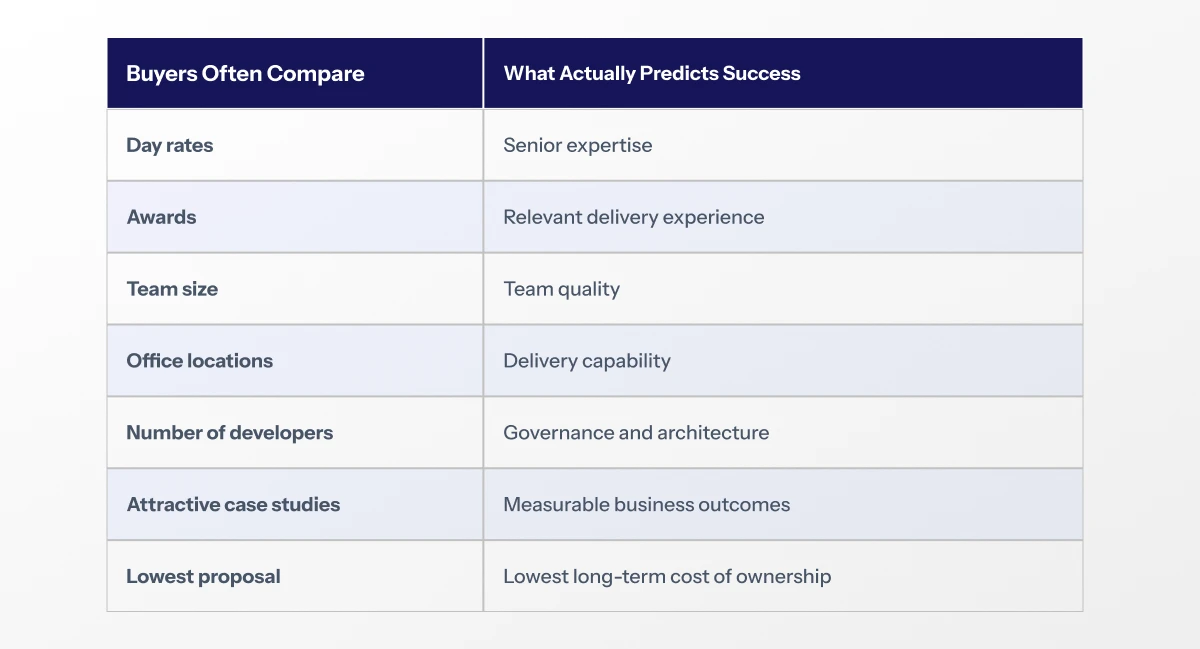
Many organisations compare agencies using the wrong criteria.
Awards.
Office locations.
Day rates.
Team size.
None of these reliably predict project success.
Instead, evaluate every agency against the areas that have the greatest influence on long-term delivery success.
8 Questions Every Buyer Should Ask
1. Which platforms do you genuinely specialise in?
Platform expertise should be demonstrated, not assumed.
A team that has launched several Shopify stores isn't automatically equipped to lead a complex Shopify Plus transformation. The same applies to Salesforce Commerce Cloud, BigCommerce and SCAYLE.
Look for evidence across implementation, integrations, migrations, optimisation and ongoing support.
Ask:
"Can you highlight recent projects on this platform with businesses similar to ours?"
2. Are you a platform specialist or a broader commerce consultancy?
Neither is inherently better. The answer depends on where your business is today.
If your platform decision has already been made, specialist expertise may be exactly what you need. If you're still evaluating technology or reshaping your operating model, broader strategic guidance can add significant value.
Ask:
"How do you decide which platform is right and when would you recommend one your agency doesn't implement?"
3. What certifications, partnerships and credentials do they hold?
Certifications should never be the only reason to select an agency. But they provide valuable evidence of recognised expertise.
A strong partner ecosystem often indicates:
Technical capability
Vendor recognition
Ongoing investment in training
Direct access to platform support
Proven delivery capability
Salesforce Credentials That Matter
The Commerce Team Global holds several notable Salesforce recognitions, including:
Independent Software Vendor status demonstrates the ability to develop Salesforce-native products and applications, extending expertise beyond implementation.
Long-term success depends on what happens after launch, not just before it. Continuous optimisation often delivers more commercial value than the initial implementation itself.
8. How will you challenge our thinking?
The best agencies don't simply execute briefs. They improve them. Expect your agency partner to question assumptions, identify risks and recommend simpler or more effective approaches where appropriate.
If every recommendation receives immediate agreement, you're hiring a supplier rather than a strategic partner.
What Buyers Often Focus On and What Actually Matters
Ecommerce Agency Red Flags
Be cautious if you encounter any of these warning signs:
A platform is recommended before your business is fully understood.
Discovery is treated as a formality.
Senior experts disappear after the sales process.
Post-launch support is unclear or treated as an optional extra.
Case studies focus on visuals rather than measurable outcomes.
SEO, performance and scalability are discussed only towards the end of the project.
These aren't just project risks. They're business risks. They're indicators of future commercial, operational and customer experience risk.
You want one partner across strategy, engineering and ongoing support.
The right answer depends on your operating model, not industry trends.
The Best Ecommerce Agency Is the One That Fits Your Business
There is no universally "best" ecommerce agency.
The right partner is the one that understands your commercial objectives, challenges your assumptions, delivers with confidence and continues creating value long after launch.
Choose the partner that's invested in what happens next. Because the success of an ecommerce project isn't measured by launch day.
It's measured by how your business performs six months, twelve months and three years later.
Frequently Asked Questions
What should I look for in an ecommerce agency?
Look for proven platform expertise, a structured discovery process, measurable case studies, strong integration capability, transparent commercial models and a clear approach to post-launch support.
Should I choose a specialist or a full-service ecommerce agency?
If your platform is already selected, a specialist may be the right fit. If you're still shaping your digital commerce strategy or evaluating platforms, a broader commerce consultancy can provide more objective guidance.
What are the biggest ecommerce agency red flags?
Weak discovery, generic case studies, unclear support models, early platform recommendations and limited senior involvement are all indicators of delivery risk.
Why is post-launch support so important?
Because performance, optimisation, security, releases and customer expectations continue long after launch. Ongoing support helps ensure your platform continues to evolve with your business.
TCTG Monitoring Solutions brings new leading RUM monitoring features for SFCC

.svg)