Storefront Next: What Salesforce's New B2C Commerce Front End Means for Retailers
Salesforce Storefront Next offers B2C retailers a modern architecture built for performance, AI-powered development and streamlined migration from traditional storefronts.
Written by
Bhumeshri Chhatani
Published on
Sep 2026
Ai Summary
Understand Storefront Next: Explore its modern React architecture, Managed Runtime, Salesforce Commerce APIs and retail-ready storefront foundations.
Explore the benefits: Discover how faster setup, performance, AI-assisted development, managed infrastructure and merchandising tools can improve ecommerce agility.
Assess migration from SFRA: Understand when Storefront Next may make sense for existing Salesforce Commerce Cloud retailers and when staying with SFRA could be appropriate.
Evaluate the business case: Consider performance, TCO, customisations, integrations, SEO, security and business priorities before deciding whether Storefront Next fits your roadmap.
This summary was created with AI and reviewed by an editor
For years, commerce teams have faced a difficult choice between speed and enterprise capability.
Easy-to-launch platforms can limit enterprise flexibility. Enterprise platforms can deliver scale, but often bring greater complexity, cost and development effort.
Storefront Next aims to narrow that gap. Salesforce's new B2C Commerce storefront combines a modern headless architecture, managed hosting, retail-focused templates and AI-assisted development with capabilities designed for the agentic commerce era.
But what does that mean for retailers and is Storefront Next the right choice for your commerce roadmap?
That's the question this article explores.
What is Salesforce Storefront Next?
Storefront Next is Salesforce's modern storefront foundation for B2C Commerce. It combines a server-first React architecture, Managed Runtime and Salesforce Commerce APIs with retail templates, Page Designer and AI-assisted development.
Three things define it:
1. Faster setup
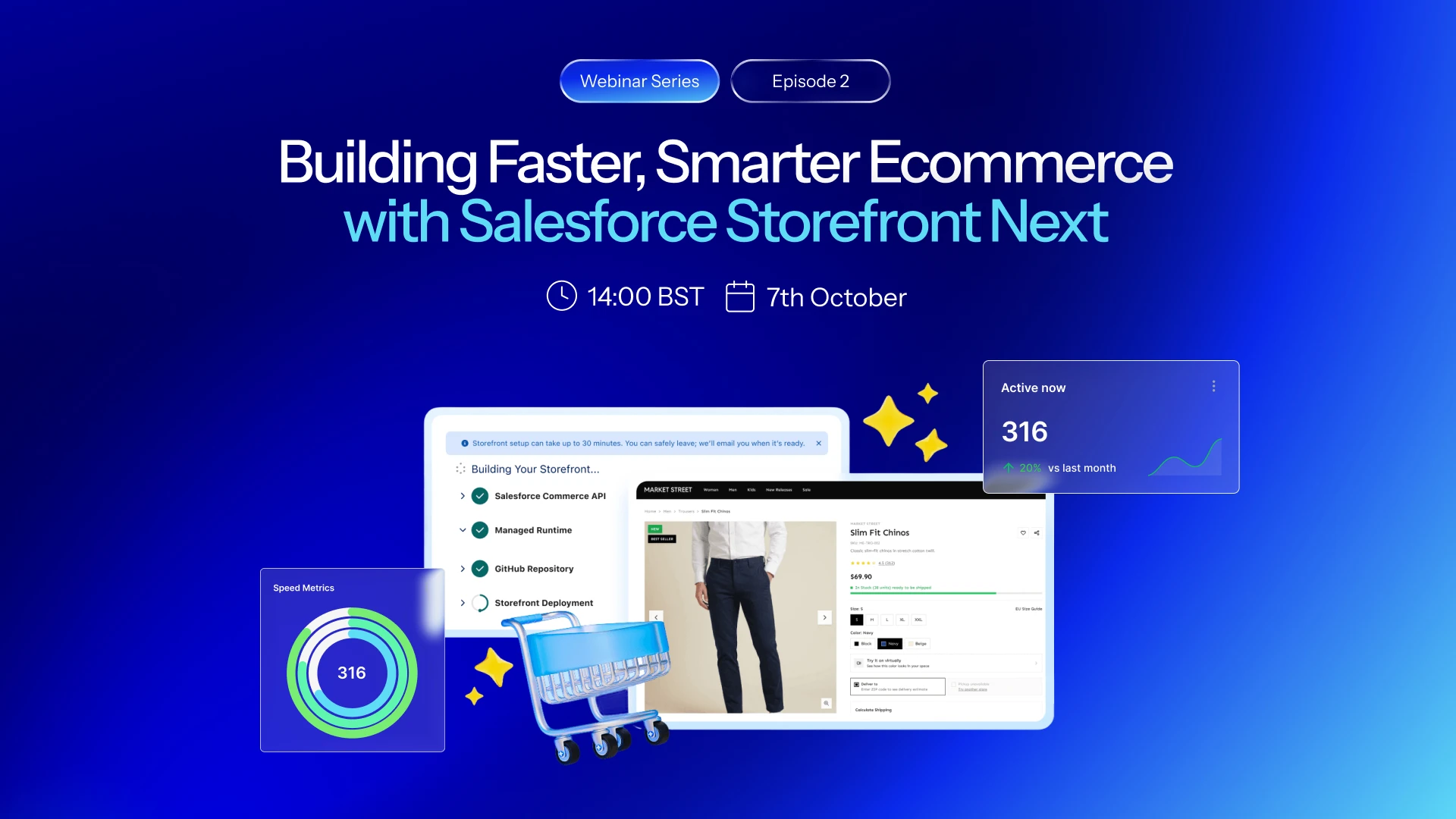
Salesforce says retailers can have a Storefront Next storefront up in less than 30 minutes through Business Manager, with a storefront template, hosting, connected APIs and a GitHub repository.
2. Retail-ready foundations
The retail storefront provides core ecommerce experiences and components rather than forcing teams to start from a blank codebase.
The clearest value: a few clicks in Business Manager produces a working storefront template, managed hosting, connected commerce APIs and a source repository. For a new brand, region or banner, that expediates what used to be weeks of scaffolding into an afternoon.
Faster implementations and lower TCO
Salesforce Professional Services puts implementations 40% faster than before. Even discounted, less bespoke plumbing and a managed runtime mean fewer developer hours and lower ongoing cost of ownership.
A modern performance stack from the start
Storefront Next uses React Router 7, Vite and Tailwind, with server-side rendering and intelligent hydration designed to support Core Web Vitals. For retailers working with legacy storefronts, the significance goes beyond a newer technology stack.
AI-assisted B2C Commerce Development
Storefront Next includes access to Salesforce's Agentic B2C Developer Toolkit, including a unified CLI, MCP Server, IDE plugins and Agent Skills for AI assistants. This reduces repetitive work, accelerates onboarding and helps developers work more efficiently with Salesforce Commerce APIs.
Retail-Ready Storefront Templates
Teams start from a high-converting baseline instead of a blank canvas, useful for smaller teams without a large front-end function.
A Streamlined Checkout Experience
The template checkout includes embedded authentication and a streamlined flow, targeting one of the most reliable revenue leaks in e-commerce. Abandonment improvements compound directly into revenue.
A Stronger Core Web Vitals Foundation
The out-of-the-box experience performs well before any optimisation work begins, a contrast to a front end that needs months of tuning to hit baseline.
Headless power without the DevOps burden
Storefront Next runs on Salesforce Managed Runtime, which provides the infrastructure for deploying, hosting and monitoring the storefront. This can reduce the operational burden associated with managing bespoke storefront infrastructure.
Merchandiser autonomy via Modern Page Designer
Storefront Next supports in Page Designer (using React components) plus reusable Content Blocks let merchandising teams assemble and reuse content across pages without a developer in the loop for every change
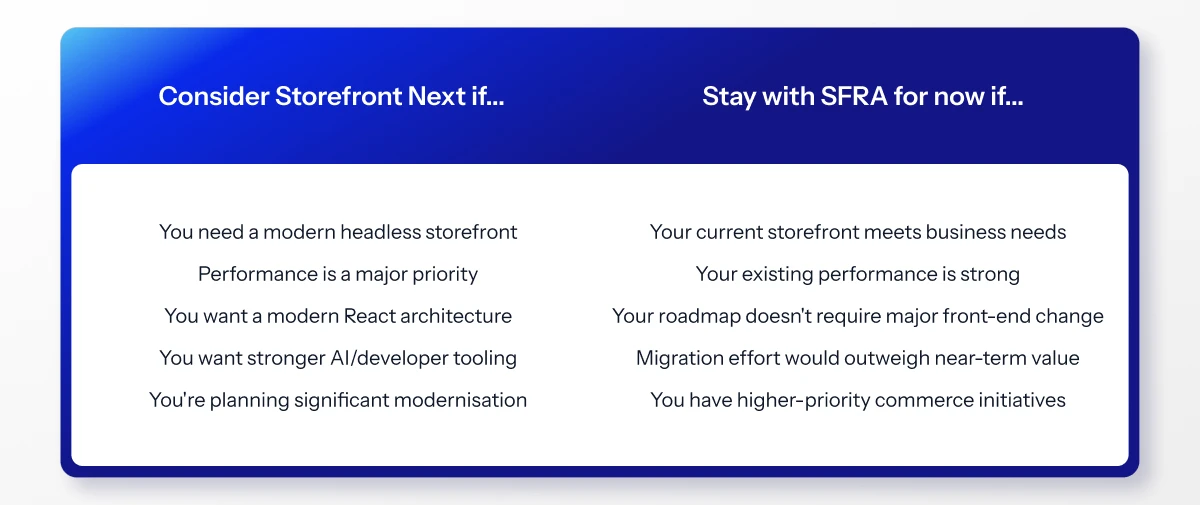
Storefront Next vs SFRA: Should Existing Retailers Move?
Storefront Next is not an automatic replacement decision for every SFCC retailer. The right choice depends on your current storefront architecture, performance, roadmap and business priorities.
The important point: Storefront Next is not automatically the right answer for every SFCC retailer.
So, Is Storefront Next Right for Your Business?
Storefront Next represents a significant change in how Salesforce approaches the B2C Commerce storefront.
For new brands, regions and greenfield builds, the combination of fast setup, modern architecture, managed infrastructure and retail-ready foundations can make it an attractive starting point.
For established SFCC retailers, the decision requires more consideration.
The performance and TCO opportunities may be compelling, but migration effort, existing customisations, integrations, SEO, security, developer capability and business priorities all matter.
The question isn't simply whether Storefront Next is better. It's whether it is better for your roadmap.

.svg)