
.svg)
AI-powered search experiences are changing how customers discover products, research purchases and make buying decisions.
According to Adobe, traffic from AI sources to retail websites grew by 393% year-over-year in early 2026, highlighting how quickly consumer search behaviour is changing.
In this article, written in collaboration with Ankit Patel, Technical Lead & AI Expert at The Commerce Team Global, we explore how AI search is reshaping ecommerce SEO and what retailers should be doing to improve visibility across AI-powered search experiences.
As platforms such as Google, ChatGPT, Gemini and Perplexity continue to integrate AI-generated responses into search experiences, the path between search and purchase is becoming increasingly shift.
Rather than sending users to multiple websites, AI search experiences often summarise information, compare products and answer questions directly within the search experience. This is accelerating the rise of zero-click search, where customers can access the information they need without visiting a retailer's website.
Success is no longer measured solely by rankings and traffic, but increasingly by whether products, content and brand expertise are visible within the AI-generated answers influencing purchasing decisions.
“Retailers must think beyond driving clicks and focus on becoming trusted sources that AI platforms reference when generating recommendations and advice.’’ says Ankit.
Traditional SEO was built around retrieval. A user searched for information and search engines returned a list of relevant pages.
GEO is built around synthesis. Yotpo highlights that AI search visibility is increasingly influenced by content extractability, structured product data and customer trust signals, making GEO a natural extension of traditional SEO rather than a replacement for it.
Recent research from Semrush found that 82% of marketers expect AI search to significantly impact organic visibility over the next two years, yet many organisations still lack a dedicated strategy for measuring AI search performance. This highlights how quickly GEO is moving from an emerging concept to a commercial priority for retailers.
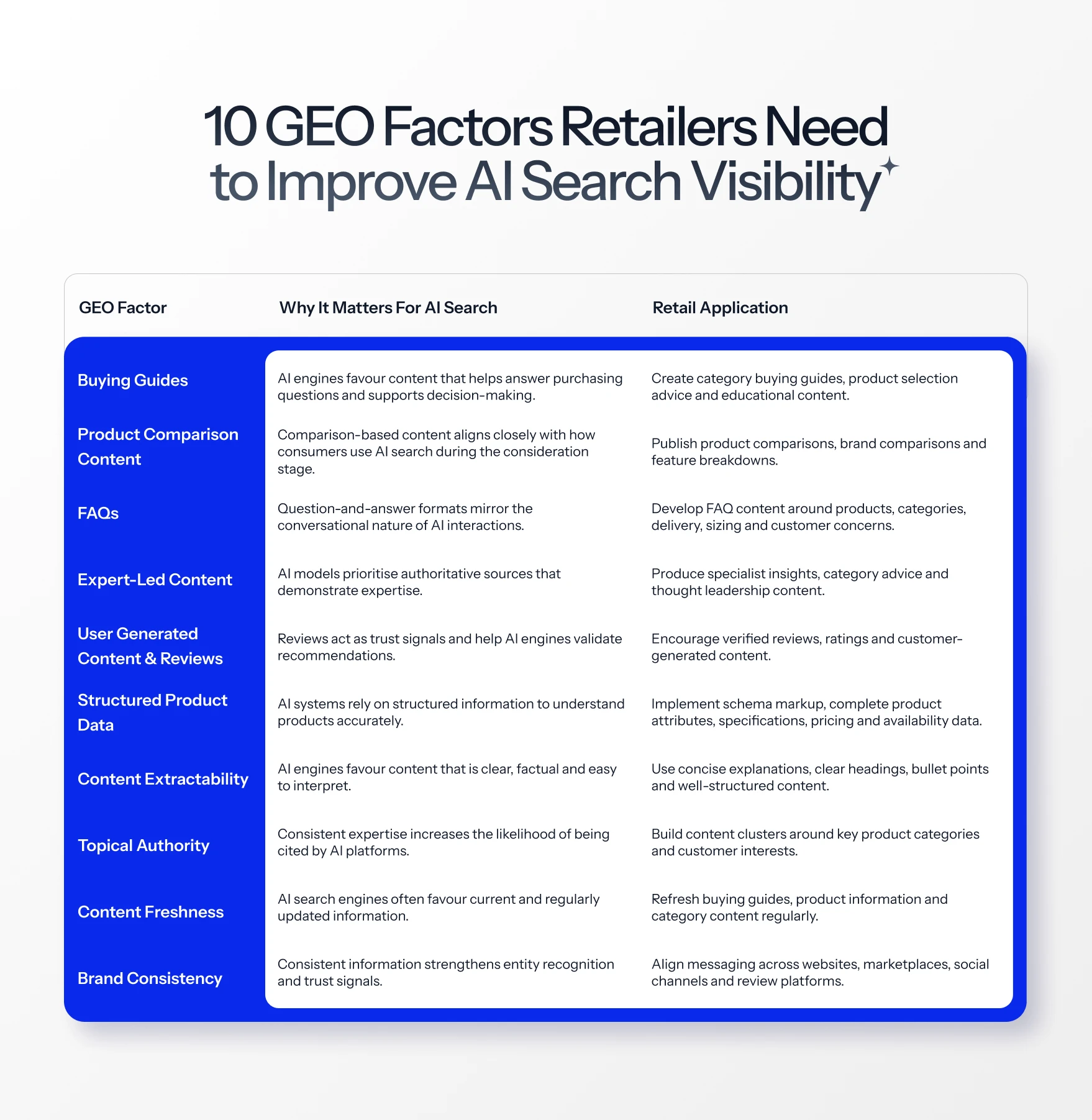
The table below summarises the factors currently having the greatest impact on AI visibility.
Adobe highlighted that many retail websites remain difficult for AI systems to interpret because their content is not sufficiently machine-readable.
As GEO becomes increasingly important, the fundamentals of SEO remain unchanged, but retailers must expand their approach to include AI visibility, structured content and machine-readable product information.
Ankit suggests that ‘’Right now, the priority should be improving product data quality, structured content, schema markup and category authority while monitoring visibility across AI search experiences. It requires expertise across ecommerce architecture, product information, content and technical optimisation.’’
This is where The Commerce Team Global helps retailers build the scalable commerce foundations needed to maximise visibility across both traditional search and emerging AI-driven discovery channels.